
Every amateur runner, when signing up for their first Half Marathon or Marathon, hears the same advice: “You need to bring running gels.” The problem is that, without clinical instruction, most athletes take the gel at the wrong time, in the wrong amount, and the wrong way.
The result isn’t more energy, but nausea, a heavy stomach, and an urgent need to go to the bathroom mid-race. A carbohydrate gel is a fantastic performance tool, but it needs to be calculated. Here is how to master this strategy.
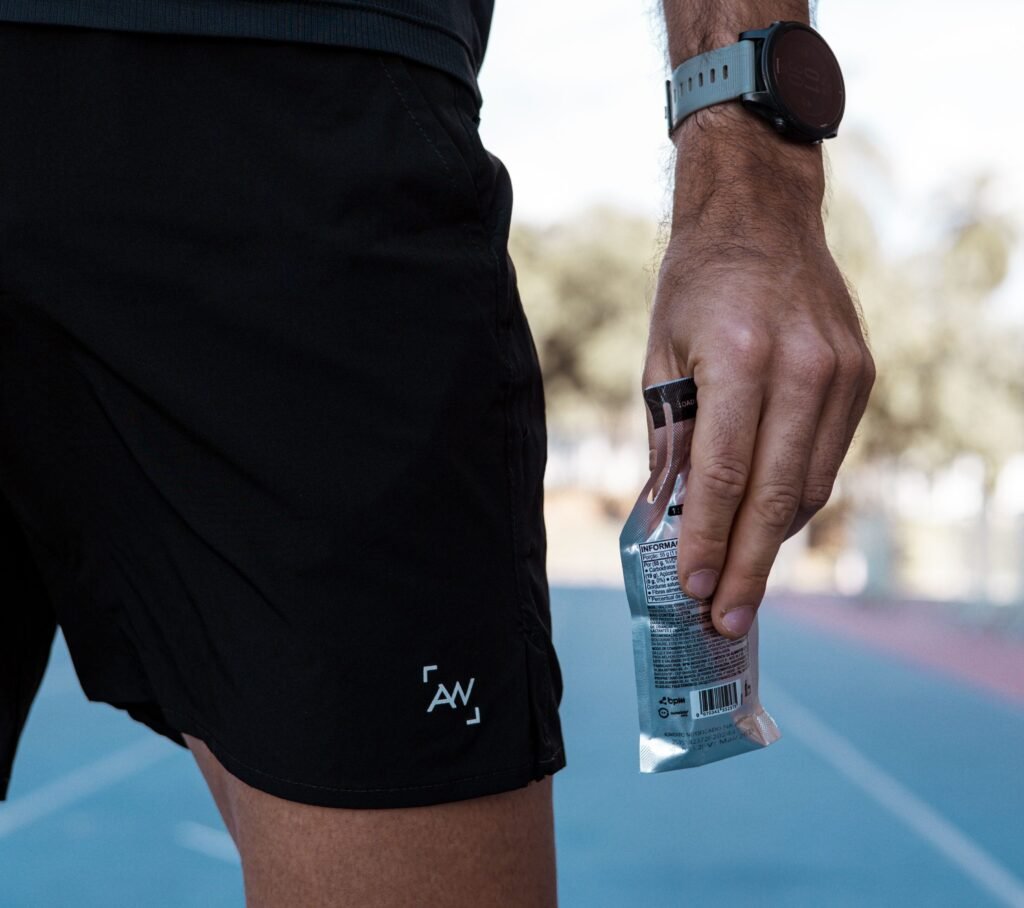
Why Do You Need a Gel? (And When You DO NOT Need It)
Your body stores energy as glycogen in the muscles and liver. This reserve is enough to sustain about 60 to 90 minutes of intense running. When the tank starts to empty (usually after the first hour), the brain sends signals of extreme fatigue. Your legs feel heavy and your pace drops. It is the famous “hitting the wall.”
The gel comes in exactly to replenish blood glucose and delay this fatigue. However, it is essential to respect the duration of the race. As we showed in our 5k nutrition guide, in short races (lasting less than 60 minutes), using a gel is useless and can even hinder you. Gels only become mandatory in workouts and races that exceed 1 hour in duration.
The Math of Energy: How Much to Take?
In sports nutrition, replenishment is not based on mileage, but on effort time. The baseline clinical recommendation for long races is to ingest 30g to 60g of carbohydrates per hour of running.
Since a standard gel sachet contains an average of 20g to 25g of carbohydrates, the practical math looks like this:
| Race/Workout Time | Recommended Strategy |
| Up to 60 minutes | Zero gel. Only water if thirsty. |
| 1h to 2h (Half Marathon) | 1 gel sachet every 40 or 45 minutes. |
| Over 2h (Marathon) | 1 gel sachet every 30 or 40 minutes (aiming for 60g/hour). |
The Biggest Clinical Mistake: How to Take the Gel
The number one mistake that destroys runners’ stomachs is swallowing the gel by itself or accompanied by an isotonic (sports) drink.
The gel is a hyper-concentrated substance. For your gut to absorb it and send it to the muscles without causing osmotic diarrhea or nausea, it needs to be diluted in pure water.
The golden rule is: always take your gel along with a cup of water from the hydration station. And speaking of hydration, don’t wait for race day to drink water; daily hydration is a very important pillar in the diet for beginner runners.
Training Your Gut (Gut Training)
Your gut is a muscle and can be trained. Never, under any circumstances, test a new brand or flavor of gel on the day of your goal race.
Your long weekend run serves precisely to simulate the official race. Test the gel ingestion at 40 minutes into your workout, see how your stomach reacts, adjust the timing, and arrive on race day with your digestion completely adapted. It is worth remembering that the gel replenishes spent energy, but what fills your tank in the days prior is a good carbo-loading.
Practical Verdict
Don’t wait for exhaustion to hit before taking a gel; replenishment is preventive, not an emergency rescue. Calculate the amount based on your predicted race time (1 gel every 40 minutes is an excellent starting point), always take it with water, and train your gut on the weekends.
By Gabriel Bueno Bocchi, Registered Dietitian / Sports Nutritionist (University of Campinas – UNICAMP)